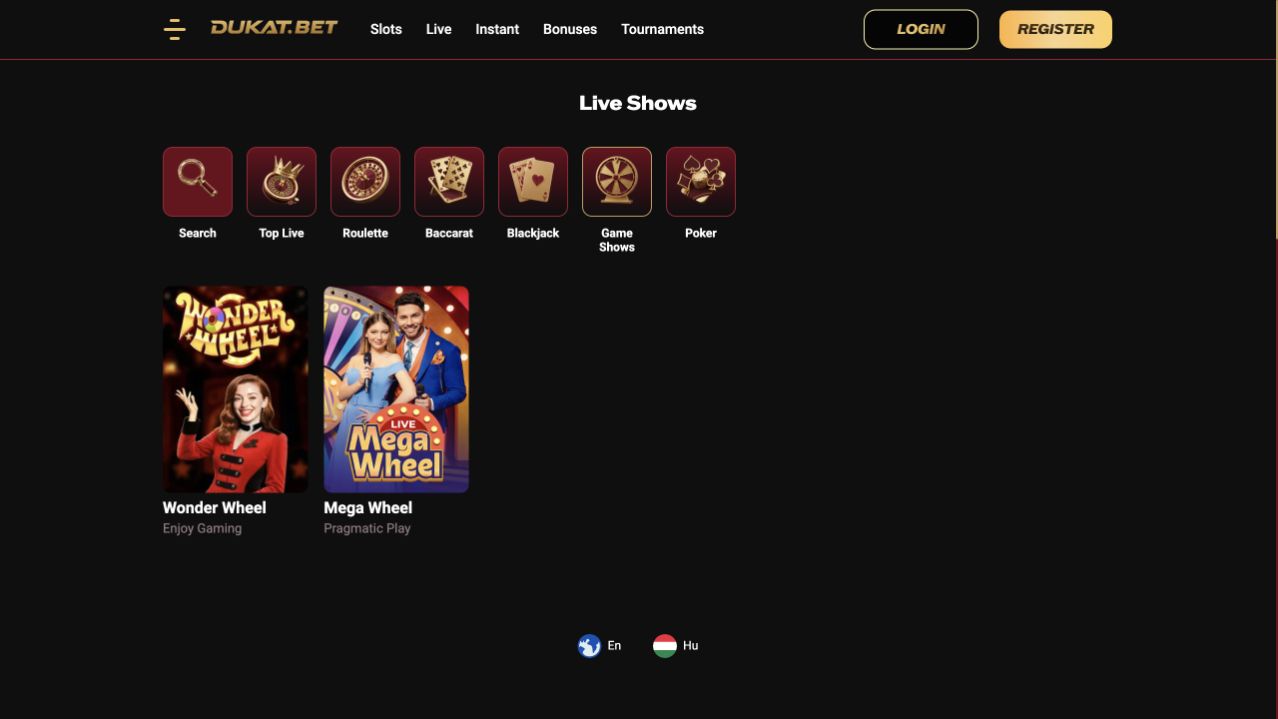
Begin with the table, not the presenter
A live-casino lobby gives a strong visual impression: a dealer, wheel or studio set can be visible before the visitor understands the rules. Start by identifying the exact table or show, its provider and the variant being offered. A broad label such as roulette or blackjack is not enough to compare payout rules, available actions or minimum stakes.
The public Dukat live area is useful for browsing those formats, but this review did not join a real-money table. A catalogue screenshot demonstrates a public listing, not an open seat, current limit or successful wager. Treat the lobby as an index that leads to the individual game information. A recognisable studio design should not substitute for that second reading step. Continue to live casino game selection to inspect the operator’s current interface.
Separate three states on the betting layout
The chip selected in a control, the amount positioned on a layout and the amount accepted for the round can be different states. An interface may show your intended choice before the betting window closes. Look for the game’s confirmation and subsequent record rather than assuming that every visual selection became a wager.
This distinction becomes especially important near a countdown or after a connection change. If you cannot tell whether the bet was accepted, do not solve the uncertainty by repeatedly adding more chips. Check the recorded state and ask about the specific round if necessary. The guide cannot certify the behaviour of every live interface, but the question to resolve is concrete: what amount and position did the operator accept?

Roulette variants require a payout comparison
A familiar wheel does not establish that every bet uses the same payout as a standard table. For example, the inspected manufacturer description of Lightning Roulette combines selected multiplier numbers with an ordinary, non-multiplied straight-up payout of 29 to 1. That should not be replaced with the usual 35-to-1 figure merely because both products use roulette terminology.
The comparison must stay with the bet type. A special multiplier may apply to a qualifying straight-up selection without changing every other position on the layout in the same way. Before placing several bets, identify the total amount spread across them and the payout rule for each. Winning on one position is not, by itself, proof that the full round produced a net profit. Continue to Dukat.bet game lobby to inspect the operator’s current interface.
Card tables introduce decisions and drawing rules
In blackjack, the permitted player actions and the dealer rules determine what decisions are available. Side bets are separate wagers with their own settlement conditions. Do not fold a side-bet return into an assumed improvement to the main game’s rule set. The individual table information is more important than a general reputation attached to the word blackjack.
Baccarat uses a different reading task: Player and Banker are betting labels, not an invitation to control the drawing sequence. The table’s automatic drawing and payout rules matter more than predicting the next hand from previous outcomes. Read any commission or alternative payout condition associated with the chosen variant rather than assuming every baccarat table settles identically.
Game shows require the winning position to have been backed
A live show can draw attention to a dramatic bonus scene even when the viewer did not place the bet that qualifies for it. The inspected Crazy Time product description, for example, includes distinct number and feature positions. Watching an event occur on the broadcast is not the same as owning a qualifying accepted position in that round.
When comparing shows, list the available betting spots, what triggers each event and which accepted stake receives the result. The total money committed can be the sum of several selections, while only one event is resolved. That makes a headline multiplier on a single spot a poor description of the overall return on a spread of bets. Do not estimate the round outcome from the most prominent animation alone.
History is a record, not a schedule
Recent-results panels make the live experience easier to follow, but they do not announce when a particular number, colour or bonus event is due. A long run without an event does not create a rule requiring it next. Likewise, a recent large result does not prove that the table will remain generous or has become exhausted.
Use history for the purpose it can support: locating a relevant round or understanding what was displayed. Avoid converting a visual pattern into certainty about the next outcome. A betting progression changes how much you expose across rounds; it does not rewrite the game’s random mechanism or guarantee recovery of earlier losses.
Check bonus eligibility before joining the round
A live title being available in the lobby does not establish that it qualifies for a deposit promotion. Account offers can define eligible games, contribution rates and excluded actions separately from the game’s own rules. If promotional credit is active, read those conditions before assuming that time spent at a table moves the wagering counter.
The operator’s progress display and the game’s result display answer different questions. One concerns promotion accounting; the other concerns a round. If they appear inconsistent, retain the table identity and account offer reference so support can inspect the appropriate records. A review-site editor cannot change either record or authorise a withdrawal.
Choose a stopping boundary outside the broadcast
Continuous presentation can make it less obvious where one session ends. Decide the money and time boundary before entering the table, rather than waiting for a particular presenter, number or bonus event. A new round appearing immediately after settlement is an available action, not an obligation to stay.
Before leaving, confirm that any accepted round has a recorded outcome and distinguish an outstanding game event from an unrelated withdrawal request. The practical aim is to leave with a clear understanding of the activity undertaken. No live format, recognised provider or high multiplier changes the possibility of losing the amount staked.